


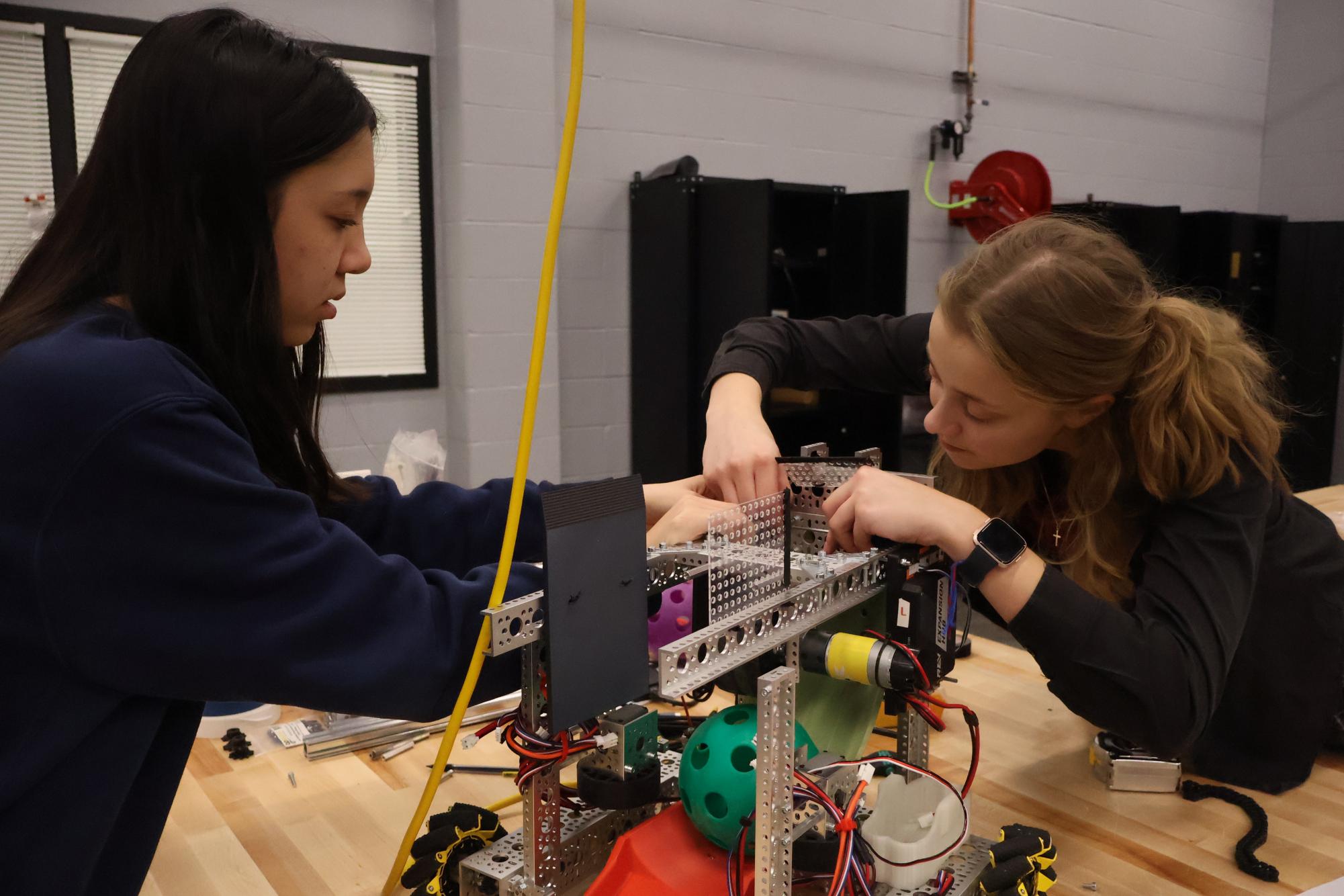
Underrepresentation is a common theme regarding women in STEM. Currently, the gender gap is ever-present and thriving, with women making up only 28.2% of the global workforce as of 2024. That gap doesn’t emerge in adulthood. It begins in the place where STEM interest first forms: in a classroom. A pair of girls sat side by side in their Intro to Engineering class, surrounded by rows of boys.
“Like a lot of the other girls in engineering at our school, I am one of the only girls in the engineering class,” freshman Brenna Pham said. “So it’s very loud, and I sit next to the only other girl. We also only talk to each other because there isn’t anyone else we can connect to easily.”
Group projects serve as a time for collaboration among the team; however, they can quickly become awkward or frustrating, as the girls are often outnumbered and overshadowed.
“You are usually in groups with a lot of guys, so especially with guys my age, they tend not to always listen and have their own ideas and get frustrated a little easier,” junior Charlotte Hillier said. “So it’s a bit of a challenge to get someone to listen and respect your own ideas.”
The fight to be heard doesn’t end after high school; instead, this pattern persists well into college. According to the World Economic Forum Global Gender Gap 2024 Report, women made up only 20.4% of U.S. engineering, manufacturing, and construction graduates: a new environment, but the same atmosphere.
“I have to speak louder,” Meimona Ibrahim, a college student at Missouri Science and Technology, said. “I’ve come to realize that I can put the same amount of effort in as they do, but I just need to make sure that it’s seen. And that can be really hard, because it’s hard to speak up when there’s only a bunch of men in the room, but the moment you do, they take notice.”
College brings forward more women into engineering—new companions to rely on, another voice in class to speak above the rest.
“I have my friends who are in my year, and we take care of each other,” Ibrahim said. “Before the career fair, we’ll get ready together. We carpool together and do interview prep together. It’s a small community, so you know everyone in that circle.”
The obstacles women face in STEM don’t look the same everywhere. Culture, opportunity, and resources vary between all countries, shaping how women enter the workforce. For example, in East Africa, according to the Kenya National Bureau of Statistics, only 21.4% of females are in STEM careers.
“In my country, Kenya, it was hard because I didn’t have any other girls or females in my class, and that was scary,” Dinah Karia, a computer scientist, said. “But after I left, I worked in the Middle East for about six years, and I got to experience a more diverse region in terms of gender.”
Engineering positions are competitive, and employers often favor men. In 2022, the UK Government released census data on occupational employment by gender. Women made up just 12% of engineering professionals, while men accounted for 88%.
Such a large gap can seem daunting, making any failure seem inevitable. However, the final obstacle to overcome is one’s own mind.
“I make sure that my previous failures would not get in the way of everything else that is coming,” Karia said. “You don’t want to make this one thing be what makes you give up. Instead, you continue observing, planning, and trying for something different.”
A field dominated by men can be a disadvantage, as it leads to a lack of diverse perspectives. More women in this line of work can open new solutions and provide a necessary viewpoint that can prove to be essential when solving problems. The Boston Consulting Group surveyed 1,700 companies and discovered that teams with more diverse management have 19% higher revenues.
“The limitations of working with only males are that they won’t understand all the problems that need to be addressed,” Karia said. “So you end up not building an application or a system that truly caters to the real problem you’re trying to solve. So with the inclusion of women, you build something with a better goal.”
Despite the challenges at each stage of a woman’s path into STEM, numbers have steadily grown. In 2009, the National Center for Education Statistics (NCES) concluded that there were roughly 140,000 women who graduated with STEM degrees. But, only seven years later, there was a nearly 43% increase, with more than 200,000 graduates.
“You’re either going to be the start of something great, or you can look and see every great woman before you who’s done the same thing,” Ibrahim said.